11/20/2026
[What’s arcane pocket change? It goes like this: in assembling a Scripta Amissa chapbook, two things happen: we compile a lot of information, filling in missing bibliographical bits and pieces; and we learn a lot about the work of the writer at the heart of the book. When the chapbook is done, you’re left with unused data. Much of it is so fine, you could sift it through silk (do you need the original and renewal registration numbers for Charles Beaumont’s “The Crooked Man” copyright? No, though you should go read the story if you haven’t, because for its time it was pretty fearless.) But some of it is more substantial and, if you’re a true literary nerd, it might be something cool to know. If you shelled out for the chapbook, then consider this a few coins in your cup…]
Was Beaumont’s First Credited Professional Writing for RCA?
While he was figuring out he wanted to be a writer, Charles Beaumont undertook a number of other jobs, creative and otherwise. He was a soldier for a bit; an actor; a railroad clerk; a disc jockey; a theatre usher. He was, somewhat notably, an artist for several fanzines and a couple of book publications, making art under a riff on his given name, Charles Nutt. (Subterranean Press, when they released Beaumont’s A Touch of the Creature, included a piece of Beaumont’s artwork in each of the lettered edition tray cases. I never hated my wallet more than when it failed me on that occasion.)
But then he sold his first story—“The Devil, You Say?” in Amazing Stories, January 1951—and was hooked up with Ray Bradbury and Forry Ackerman, and he was well and truly on his way to the writer everyone knows. Except maybe, right before that first sale, Beaumont might have used his appreciation of classical music to somewhat different effect.
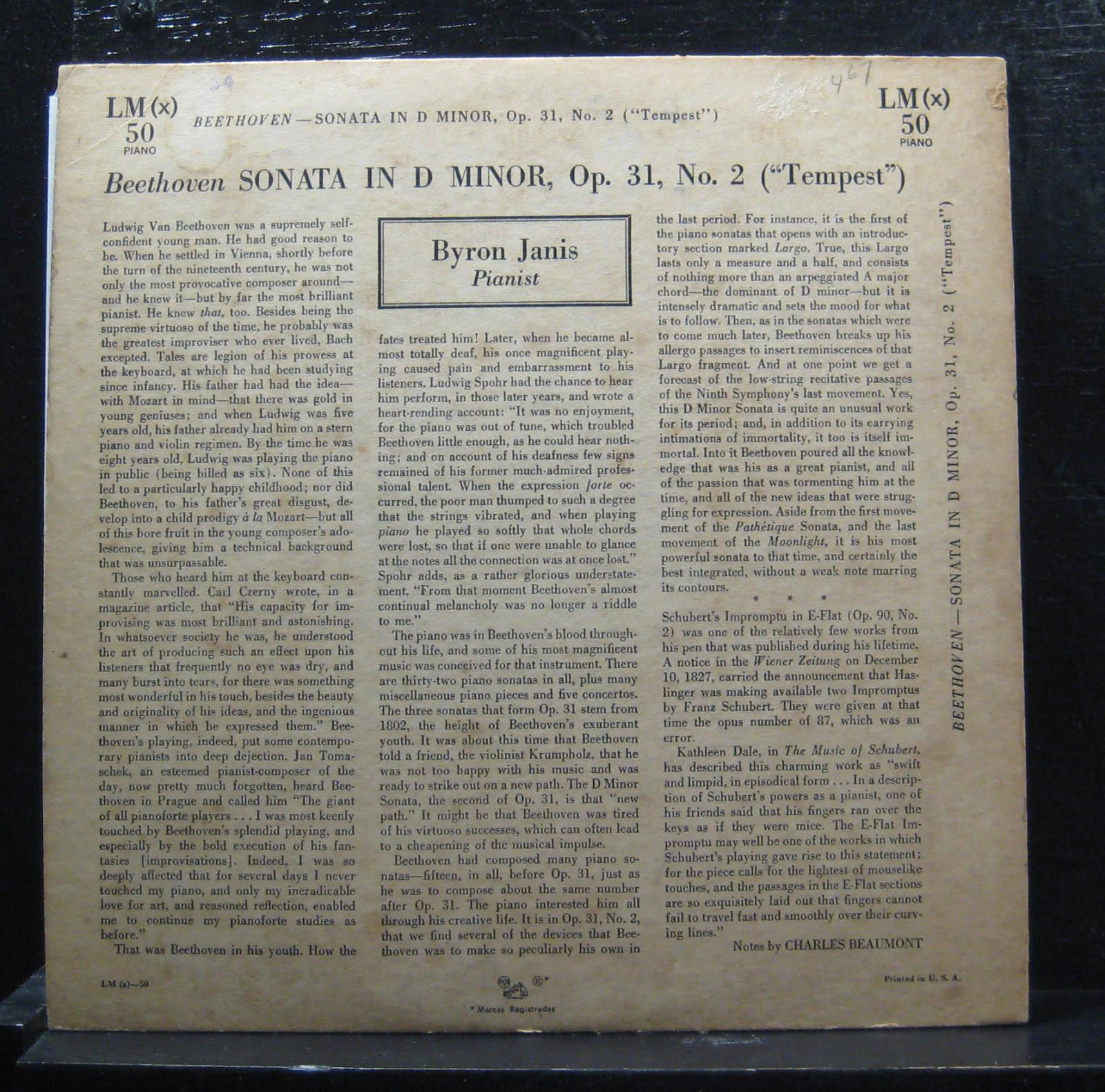
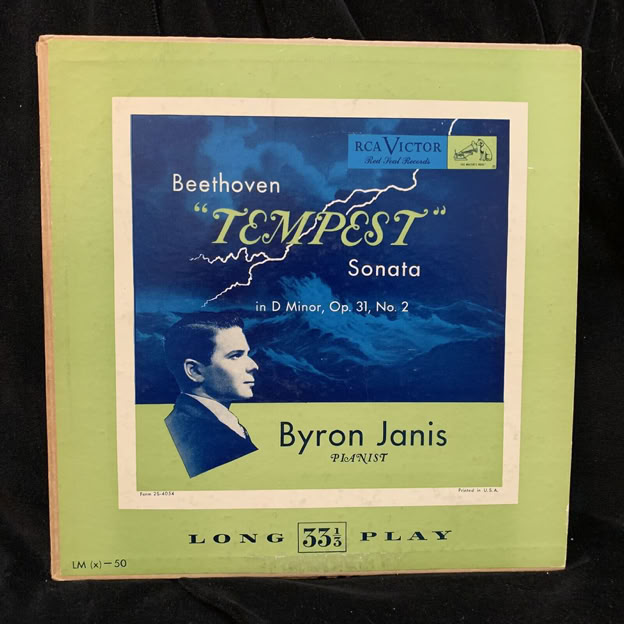
RCA released a broad range of classical recordings throughout the 1940s and 1950s, in a variety of formats ranging from sets of 45 rpm microgroove records, to 10-inch and 12-inch LPs. Six releases in 1950 grouped closely by catalog number (three each in the 10- and 12-inch lines) have liner notes credited to a Charles Beaumont. The six comprise about 6,000 words and include:
LM 50 – Sonata for Piano in D Minor, Op. 31 (Beethoven) – Byron Janis
LM 52 – Piano Quartet No. 1 in C Minor, Op. 15 (Fauré) – Artur Rubinstein and Paganini Quartet
LM 58 – Beloved Hymns – Blanche Thebom, Forsberg at the Organ
LM 1118 – Toscanini Conducts The Moldau, Danse Macabre, and The Sorcerer's Apprentice – Arturo Toscanini and NBC Symphony Orchestra
LM 1122 – Helen Trabuel Sings Wagner – Helen Traubel, Frieder Weissmann and the RCA Victor Orchestra
LM 1123 – Helen Traubel Sings Wagner Volume 2 – Helen Traubel, Frieder Weissmann and the RCA Victor Orchestra
It's known Beaumont appreciated classical music, and that he knew his way around a hi-fi (he'd write a couple of articles for Fortnight magazine in the mid-fifties on the subject). But are these notes by the Charles Beaumont? A dive of RCA liner notes suggested they used a lot of different writers, some uncredited; other notes were credited to books on classical music. If records exist that could prove conclusively that this Beaumont would go on to write fantastic fiction, their whereabouts are unknown.
That just leaves the words to judge by. Consider an excerpt from Helen Traubel Sings Wagner Vol. 1:
A legend that has its roots in German mythology is the story of Tristan and Isolde. Wagner started to think of composing a music drama on the subject in 1854. Working on it intermittently at first, furiously later, Wagner had the score finished in August of 1859. The first performance was given in Munich on June 10, 1865, with Hans von Bülow conducting. It came as a thunderclap to Europe; it was to opera what the Eroica had been to symphony a few generations back. It is safe to say that Tristan und Isolde contains the essence of Wagner—a quality part sensuous, part philosophical, part metaphysical, heavily Teutonic, filled with passionate melody and a type of harmony that pushed chromaticism almost to its limits.
Or from Piano Quartet No. 1 in C Minor, Op. 15 (Faure):
When Fauré was born, on May 12, 1845, Mendelssohn, Schumann, Chopin and Berlioz were still alive. When he died, on November 4, 1924, it was the age of Stravinsky, Schoenberg and Prokofieff. What artistic and cultural changes the long-lived Fauré saw! Wagner and Liszt exerted their influence; Meyerbeer had his day; Franck gathered to his bosom a whole generation of French musicians; Mahler came and went. And through it all moved the gentle, meditative Gabriel-Urbain Fauré, cultivating his own garden, influencing—as teacher as well as composer—many of the present century's composers.
They certainly have the energy and exuberance one finds in Beaumont’s nonfiction of several years later; nor is the style grossly dissimilar from his. But it’s also hard to say definitively outside the circumstantial evidence. If it is him, one wonders about the circumstances: was it a trial period, a brief employment stint long forgotten in a list of them, a quick gig to pay the bills? Short of a draft showing up in his papers, we may never know. And RCA will be no help, records or not: suggestive of work-for-hire, with the 1956 reissue of the Toscanini album, the 1950 liner notes were reused but the Beaumont credit was removed, replaced by a 1956 copyright notice for RCA for the work.
Before “Beyond the Fire”
As a racing enthusiast, Beaumont was plugged into the markets for racing-themed material. Fiction, race reports, auto previews, letters, features covering Grand Prix races—auto-centric material appeared in close to a dozen publications, not counting the creation with Bill Nolan of two anthologies of race writing.
Among the published pieces was the one-page story “Beyond the Fire” that appeared in Road and Track’s January 1959 issue. Clocking in a shade under 700 words, it brings us an Elder and the Boy to whom he tells the story around a campfire of how automobiles wiped out mankind. “Beyond the Fire” has been anthologized a couple of times by the magazine’s editors, but has never appeared in a Beaumont collection.
Except Road and Track marked the story’s second appearance. Its first, in slightly longer form, was in the Books section of The Los Angeles Times Sunday edition on September 28, 1958. Under the title “Monsters: the Day They Took Over,” the piece is generally the same save for a key element: it was also a tongue-in-cheek, highly stylized review of John Keats’s The Insolent Chariots, a critique of the U.S. automobile industry published eleven days earlier. In addition to making many small revisions to the text, the Road and Track version eliminates Beaumont’s direct jabs at Keats and his book:
“Beyond the Fire” version:
“And did no one fight them?” asked The Boy.
“It is difficult to say. A few did, perhaps. Not many. And that pitiful few had, I am afraid, more enthusiasm than skill. They did not understand the nature of the beast. They thought that the monsters could be conquered by laughter. But when you are threatened by a real danger, my son, you do not laugh at it. You take up arms against it. The warriors failed.”
Original “Monsters” version:
“And did no one fight them?” asked The Boy.
“A few did,” said The Elder. “A great warrior was John Keats. He fought them. He wrote a book called THE INSOLENT CHARIOTS, in which he hoped to show how men could survive the attack. But, unfortunately, he had more enthusiasm than skill. He did not understand the nature of the beast. He thought that laughing at The Monsters would demoralize them. But when you are threatened by a real danger, my son, you do not laugh at it. You take arms against it. His book was interesting to read, but it was a poor weapon.”
“What happened to this Keats, Father?”
“He was consumed by one of the most vicious and frightening of all the Creatures — the Finned Station Wagon!”
If Keats had a rebuttal, it has not yet been found.
SPEAKING OF WANTING TO FIND
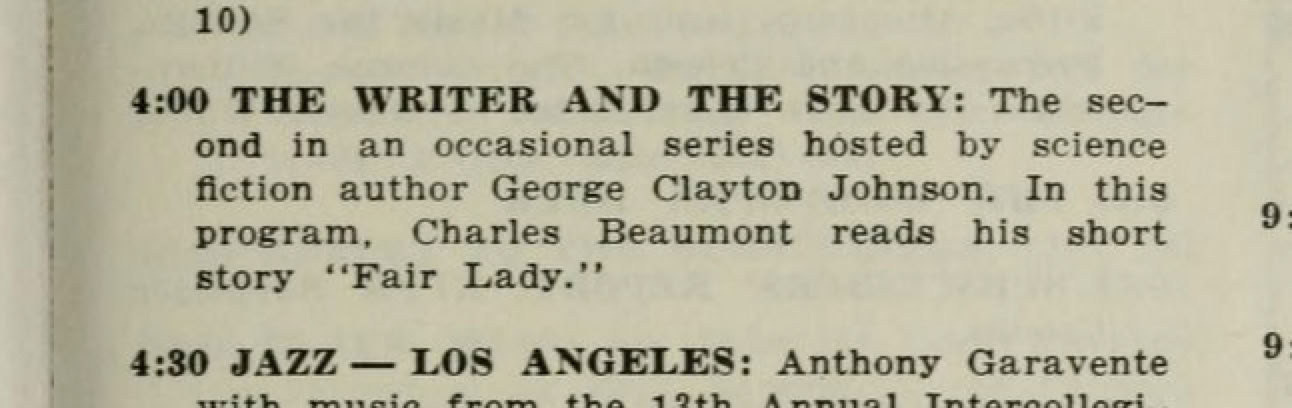
Pacifica Radio—with its vast archive of tape being cataloged and preserved—may have some of the rarest coin of all left in the Beaumont purse. In 1964, Beaumont friend and cohort George Clayton Johnson hosted what was described as an “occasional” show for station KPFK Los Angeles, called The Writer and The Story. Johnson would have several of his compatriots from the “California School” of writers on the show. In June 1964, the series aired a Charles Beaumont episode, during which Beaumont was to read the story “Fair Lady,” an older tale from 1959’s The Hunger and Other Stories. Pacifica previously identified and transferred an episode on which Jerry Sohl appeared; if their archives are as complete as one hopes, the station archive may have the only known recording of Beaumont reading his work. And that’s lost work worth mining for. (Illustration from the KPFK programming folio for June 1964.)
(c) 2026, Douglas J Lane